Before the send button
BNB Deposit Checklist: What to Match in the Cashier and in Your Wallet Before You Send
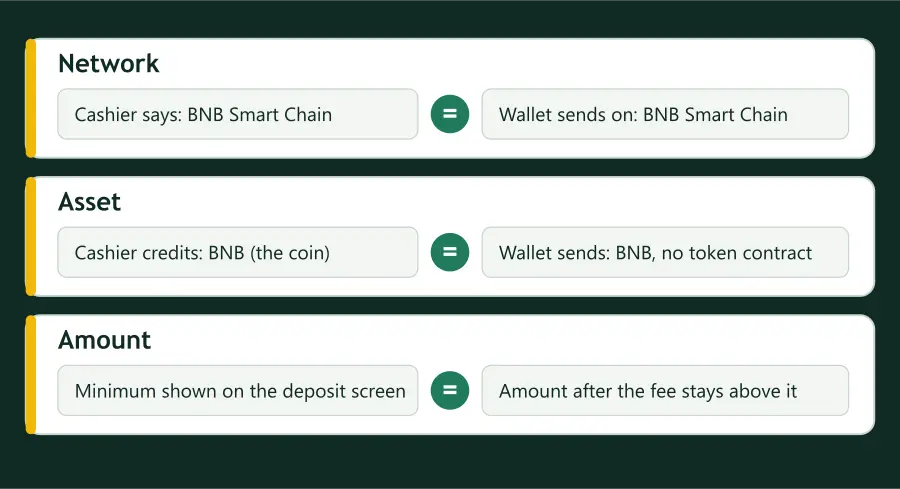
Every BNB deposit is two screens that have to agree: the cashier, which says where the coins should go, and the wallet, which decides where they actually go. This page gives the order in which to compare them, so the comparison happens while a mistake still costs nothing.
The subject here is the routine you run before the transfer exists, in four lines and one trial run. Why a single address shape can serve more than one network, and how a payment ends up on the wrong one, is a separate question that this page leaves alone.
Which network does the cashier ask for, and which one is your wallet sending on?
Start with the word the cashier uses. Cloudbet’s deposit guide turns it into an instruction: from the network list, select the correct network and check the minimum deposit required. For BNB the name you want is BNB Smart Chain, which wallets and exchanges also shorten to BSC and label BEP-20. Stake writes it as BSC (BEP20) network, Duelbits as Binance Smart Chain and Cloudbet as BNB Smart Chain: three spellings of one network.
Then read the matching word on the wallet’s send screen, in the field that names the network or chain, not in the name of the coin. The coin reads BNB on both screens whichever network sits underneath, so a matching coin name proves nothing. Duelbits states the rule in a sentence: always match the network you select with the one supported by your deposit wallet. If the two names differ in any way you cannot explain, stop and change one of them before going on.
An address will not settle the question for you. The validation rule in the currency data on Cloudbet’s fees page accepts a BNB address of the form 0x followed by forty hexadecimal characters, and that is also the shape of an Ethereum address. A wallet that accepts the address has told you only that the shape is valid.
Is it BNB itself, or a token that lives on the same network?
The second line is the asset, and it is a different question from the network. BNB Smart Chain carries its own coin, BNB, and also a long tail of tokens, among them wrapped versions of Bitcoin and several dollar stablecoins. Tokens share the network and the address shape with the coin, but they are separate assets, and a cashier credits the asset it expects.
Operators draw the line in their own data. In the currency data on Cloudbet’s fees page the BNB entry on BNB Smart Chain has no contract address, while the Bitcoin entry for the same chain carries one, because it is a token contract rather than the chain’s own coin. Duelbits lists a Binance Smart Chain version of Tether in the same table as BNB. Stake lists BNB on BSC (BEP20) and, in a separate list of networks it does not support, includes tokens on the BEP20 network. Our reading is that Stake takes the coins it names on that network and not every token that happens to live there; Stake does not phrase it that way, so settle it in the cashier’s asset picker.
Roobet describes the consequence bluntly: it accepts a closed list of coins, BNB among them, and says that sending any other cryptocurrency or tokens will result in it being lost and the account not being credited. In the wallet, the practical check is the asset name on the send screen: it should read BNB, with no contract address attached and no second token name beside it.
Will the amount still clear the minimum after the network fee?
Sportsbet.io’s home page says it in a sentence that is worth reading twice: “Deposit minimums are the amount Sportsbet.io receives after network fees, so send slightly more than the floor.” It adds that minimums are reviewed periodically and that the cashier always shows the current figure.
That sentence is the whole check. An amount that equals the minimum on the sender’s side can be smaller by the time it arrives, and a transfer under the floor is not a small deposit but an uncredited one. Rollbit prints the consequence in capitals: deposits below its minimums will not credit and cannot be recovered by its support. Its BNB figure is 0.01, from an article dated August 2026, and the cashier shows what applies today.
Where the fee comes from depends on what you send from. A wallet holding BNB pays the network fee in BNB on top of the amount, while an exchange withdrawal screen often takes the fee out of the amount and shows a line for what will arrive. Read that line. Rollbit’s article notes that you pay on-chain gas fees when sending from your own source address, which is a good reason to leave a little BNB in the wallet instead of sending the whole balance.
Does the cashier show an extra field next to the address?
Some coins need a memo or tag beside the address, and the cashier is the only reliable place to learn it, because it is the party that has to match the payment to your account. Cloudbet’s guide says so in one line: if needed, copy tag/MEMO and paste it into your wallet. In Cloudbet’s own currency data the entry for BNB carries no tag flag, while the entry for a coin that does need one carries it.
So the rule runs both ways. If the cashier shows a memo box for BNB, copy it exactly. If it shows none, do not invent one, and do not carry over a tag from another coin’s deposit screen that you used earlier. When in doubt, reopen the deposit screen, choose BNB again and read it from the top.
A small transfer first, then the real amount
On a cashier that is new to you, the cheapest verification is a first transfer that is small but safely above the minimum, followed by the full amount once the first has appeared in your balance. It costs one extra network fee and removes the case where a mistake repeats at full size.
It does not replace the four lines above. A test sent to the wrong network is lost as completely as a large payment; the trial only limits how much is at stake while you find out.
What twelve operators publish about BNB, in one line each

Stake
Lists BNB on the BSC (BEP20) network and keeps a separate list of networks it does not support.

Roobet
Names BNB in a closed list of accepted coins and gives no network for it.

BitStarz
Lists Binance Coin; its page data names BNB Smart Chain while the visible table shows a minimum of 0.

Cloudbet
Names BNB Smart Chain and publishes the address shape and both BNB minimums in its currency data.

Rollbit
States a 0.01 BNB minimum and warns about wrong networks, without naming one for BNB.

BC.GAME
Its page text lists other coins and not BNB, and the cashier could not be read.

Duelbits
Names Binance Smart Chain in its network table and spells out what a wrong network can cost.

BetFury
Counts BNB among accepted currencies and tells you to check all the data; no network named for it.

Vave
Its coin list from 2023 does not name BNB, and it does not claim to be complete.


Sportsbet.io
Lists BNB among accepted currencies and counts deposit minimums after network fees.

CoinCasino
The cashier we could read cannot be tied to this brand, so nothing is claimed.
Short answers
Is BNB Smart Chain an Ethereum network?
No. It is a separate network with its own coin, BNB, and its own explorer. It reuses the Ethereum address shape, which is why a wallet cannot tell the two apart from an address alone.
Can a transfer sent on the wrong network be recovered?
Do not plan on it. Rollbit says funds are generally unrecoverable if sent via the wrong network, Duelbits lists irretrievable funds among the outcomes, and Sportsbet.io says crypto sent to the wrong network or address can’t be recovered.
Do I need all four checks for a small deposit?
Yes. The checks take under a minute, and a small transfer sent the wrong way is lost as completely as a large one.